
Lawn
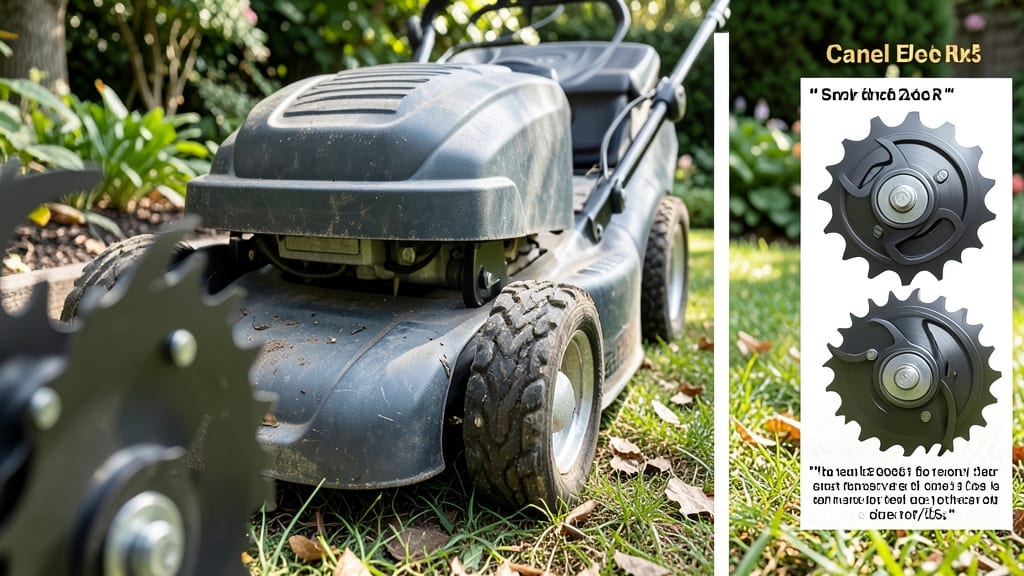
A rotary lawn mower cuts grass using a spinning horizontal blade that lifts, shears, and throws clippings outward, making it ideal for larger lawns with thick grass. Unlike reel mowers, it handles weeds and uneven terrain better but may leave slightly uneven cuts.
A rotary lawn mower uses a spinning horizontal blade that rotates at high speeds (typically 3,000-3,600 RPM), creating centrifugal force to lift grass blades before cutting them cleanly.
This design makes it perfect for large yards or areas with thick, overgrown grass, as the blade's motion also helps distribute clippings evenly. 🌿 Unlike reel mowers, which rely on vertical cutting like scissors, rotary mowers can tackle uneven surfaces and weeds more effectively, though they may require more frequent sharpening to maintain a clean cut.
The key advantage of rotary mowers is their versatility—they handle everything from tall grass to weeds with ease, while reel mowers excel on smooth, flat surfaces with short grass.
Many homeowners choose rotary mowers for their durability and ability to mulch clippings, though they tend to be louder and heavier than reel models.
💡 In This Article
- How Rotary Lawn Mowers Work: Blade Mechanics and Cutting Process
- Rotary vs Reel Mowers: Which Is Best for Your Lawn?
How rotary lawn mowers work: blade mechanics and cutting process
The spinning blade of a rotary lawn mower operates on a principle called centrifugal force, where the blade's rotation (typically 3,000-3,600 RPM) creates outward pressure that lifts grass blades vertically before cutting.
This happens because the blade's angled cutting edge (usually 35-45 degrees) catches the grass and throws it upward, allowing the sharp underside to shear through the stem. The faster the blade spins, the higher the grass is lifted, ensuring cleaner cuts even on thick, tangled grass.
Here's what's actually happening at a microscopic level: as the blade rotates, its sharp leading edge slices through grass stems while the trailing edge (often slightly duller) helps lift the clippings. The centrifugal force also creates a vacuum-like effect beneath the blade, which helps pull grass into the cutting path.
This is why rotary mowers can handle uneven terrain—the blade maintains contact with the ground even on slopes, unlike reel mowers that require perfectly flat surfaces to function effectively.
The blade's design plays a huge role in performance. Most rotary blades feature 4-6 cutting edges arranged in a spiral pattern, which means each revolution produces multiple cuts.
For example, a 4-edge blade spinning at 3,400 RPM makes 13,600 cuts per minute—far more than a reel mower's single vertical cut.
This rapid cutting action also generates the characteristic thumping sound you hear while mowing, which comes from the blade's impact with the grass and the engine's power delivery.
What most people don't realize is how the blade's height adjustment affects the cut. When you raise the blade, you're changing the angle at which it meets the grass.
A higher setting (3-4 inches) means the blade lifts grass more aggressively, while a lower setting (1-2 inches) produces a closer cut but requires more frequent sharpening.
This is why many manufacturers recommend keeping the blade sharp—dull blades tear grass instead of cutting cleanly, leading to ragged edges and brown tips.
Compared to reel mowers, which use two vertical blades like scissors, rotary mowers offer three-dimensional cutting action. The spinning motion allows the blade to cut grass at multiple angles simultaneously, making it far more effective on broadleaf weeds and clover.
However, this comes at a trade-off: the shearing action can sometimes leave grass blades with small tears rather than clean cuts, which is why rotary mowers often require more frequent mowing to maintain a healthy lawn.
Consider these key factors when understanding the cutting process:
- Blade speed: Faster RPMs (3,600) create more lift and cleaner cuts but require more engine power
- Blade angle: Steeper angles (45 degrees) cut better but wear faster than shallower angles
- Cutting height: Lower settings (1.5 inches) produce finer clippings but stress the grass more
- Terrain impact: Uneven surfaces force the blade to work harder, increasing wear on the cutting edges