
Lawn
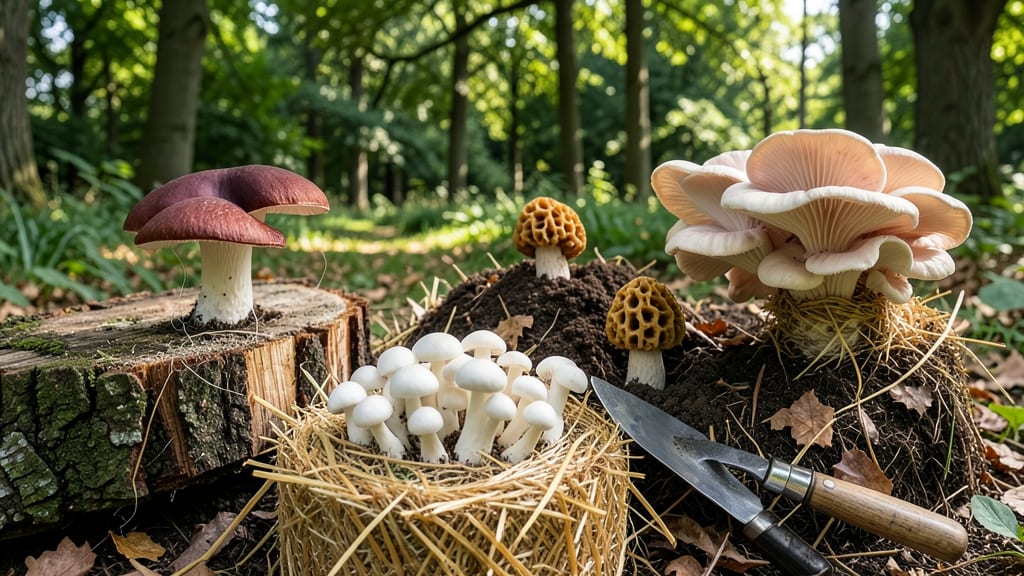
The most common lawn mushroom types include meadow mushrooms (Agaricus campestris), parasol mushrooms (Macrolepiota procera), and field mushrooms (Agaricus arvensis), all of which grow naturally in grassy areas with partial shade, consistent moisture, and well-drained soil. For the best flavor and texture, harvest them when their caps are fully expanded but before they release spores.
Lawn mushrooms aren't just one type—they're a diverse group of wild edibles that thrive in your backyard if conditions are right. 🌱 Meadow mushrooms, for example, have a classic umbrell shape with white gills that turn pinkish-brown with age, while parasol mushrooms stand out with their tall, slender stems and scaly caps.
These varieties love damp, grassy patches but need good airflow to prevent rot. The key to identifying them safely is checking the gill attachment (free vs. attached) and spore print color—reddish-brown spores are a dead giveaway for many edible species.
What makes these mushrooms special is how adaptable they are. They'll pop up after rain in lawns, meadows, or even along roadsides, but they won't grow in compacted or waterlogged soil.
If you're trying to encourage their growth, focus on areas with partial shade (like under trees) and avoid heavy foot traffic. And remember: always double-check with a field guide or expert before eating any wild mushroom—some lookalikes can be dangerous.
💡 In This Article
- Identifying Common Edible Lawn Mushroom Species
- Optimal Conditions for Growing Lawn Mushrooms
Identifying common edible lawn mushroom species
The most reliable way to distinguish edible lawn mushrooms starts with their cap shape and gill structure. Meadow mushrooms (Agaricus campestris) have convex caps that flatten with age, ranging from 1-4 inches wide with a white to tan color.
Their gills are free-standing (not attached to the stem) and initially white, turning pinkish-brown as they mature—a key identification marker. 🔥 Parasol mushrooms (Macrolepiota procera), on the other hand, boast scaly, bell-shaped caps that can reach 6-12 inches wide, often with a volva (cup-like base) at the stem's bottom, a feature absent in meadow mushrooms.
Spore print color is another critical clue. When you gently place a mature cap gill-side down on white paper overnight, edible meadow mushrooms will leave a rusty-brown print, while parasol mushrooms produce a pinkish-brown hue.
Field mushrooms (Agaricus arvensis) follow a similar pattern but typically grow in tighter clusters and have a more fibrous stem. The scent is also telling—edible species often smell nutty or anise-like, while toxic lookalikes may have a foul or chemical odor.
Always cross-reference with a field guide, as some deadly doppelgängers (like the deadly galerina) mimic these species.
Texture plays a role too. Edible lawn mushrooms have firm yet tender flesh that bruises slightly when handled but doesn't turn slimy. The stems should be hollow or fibrous when mature, not solid.
For example, a parasol mushroom's stem might feel spongy near the top due to its rapid growth. 🌱 What most foragers overlook is the ring (annulus) on the stem—many edible species have a movable ring that slides up and down, while toxic varieties often lack this feature or have a fixed ring.
Seasonal timing matters for identification. Meadow mushrooms typically appear late summer to fall after heavy rains, while parasols emerge spring to early summer. Field mushrooms thrive in cooler months and often grow in grassy fields or lawn edges.
This timing helps narrow down possibilities—seeing a parasol in October? It's likely a different species entirely. Always harvest from chemical-free areas and avoid mushrooms growing near roadsides or industrial zones, as they may absorb toxins.
One common mistake is confusing edible lawn mushrooms with the destroying angel (Amanita bisporigera), which has a white cap, free gills, and a sac-like volva but lacks the nutty aroma.
The destroying angel's spores are white, not brown, and its flesh remains unblemished when cut (edible species bruise). 💫 Another lookalike is the fool's mushroom (Fomitopsis rosea), which grows in clusters and has a reddish-brown cap with pores instead of gills—a dead giveaway for inexperienced foragers.
For a foolproof ID, combine these visual cues with a spore print test and a smell check. If you're still unsure, consult a local mycology group or use a DNA-based field kit for confirmation.
Remember: When in doubt, throw it out—mushroom poisoning cases often involve misidentification of species that look nearly identical to edible varieties.