
Mower
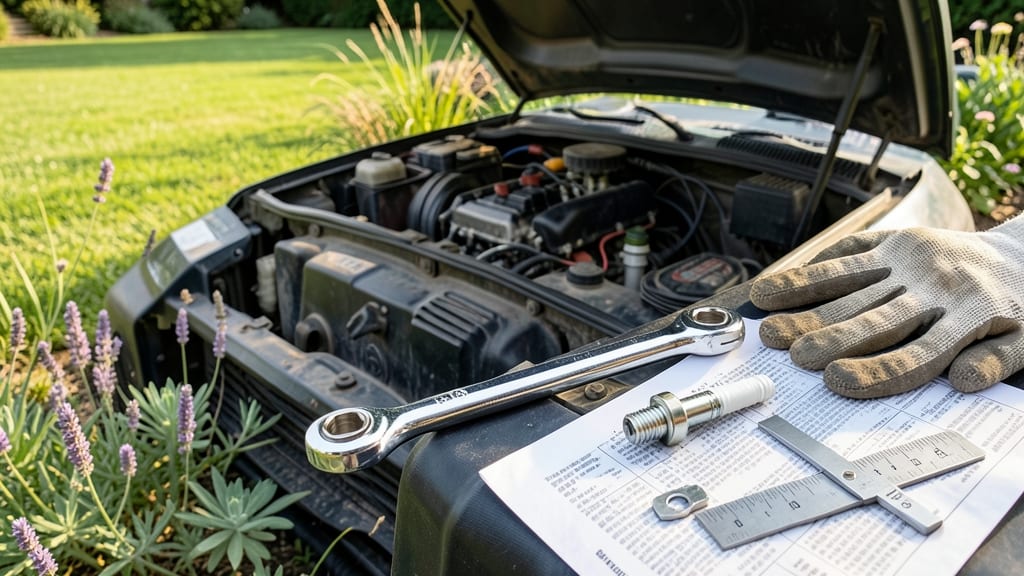
To find your lawn mower spark plug size, check the manufacturer's manual or engine label—most small engines use sizes between 0.025 and 0.045 inches. If those aren't available, measure the gap with a feeler gauge or consult a spark plug size chart for your specific engine type.
Lawn mower spark plugs come in various sizes depending on the engine manufacturer and model. 🔧 The most reliable way to confirm yours is by locating the model number on the engine housing or deck—this often reveals the exact plug specification.
For example, Briggs & Stratton engines typically use 0.025-inch gaps, while Honda models might require 0.030-inch. If you're unsure, a simple feeler gauge test takes just minutes and prevents costly mistakes during installation.
What's interesting is how the gap size directly impacts engine performance. A gap that's too wide can cause misfires, while one that's too narrow leads to overheating.
I always recommend double-checking with a manufacturer's chart if you're replacing multiple plugs—even slight variations can make a difference in how your mower runs.
💡 In This Article
- Where to Locate Your Lawn Mower Spark Plug Size by Engine Type
- Top 5 Tools to Measure Spark Plug Gap Accurately
Where to locate your lawn mower spark plug size by engine type
Lawn mower spark plug sizes vary dramatically based on engine type, and manufacturers often encode this information in specific locations.
For most small engines like Briggs & Stratton or Toro, the size is printed on a sticker near the valve cover or on the engine housing—look for labels marked "Spark Plug Size" or "Gap."
For example, a Briggs & Stratton 19cc engine commonly uses a 0.025-inch gap, while a Honda GCV160 typically requires 0.030-inch. The plug itself also provides clues: measure the thread diameter (often 10mm or 14mm) and the reach length (distance from gasket to tip) to narrow down the size.
Two-cycle engines (like those in some riding mowers) often use smaller plugs with 10mm threads and 0.020-0.025-inch gaps, while four-cycle engines (common in walk-behind mowers) favor 14mm threads and 0.030-0.045-inch gaps.
The engine's displacement (measured in cubic centimeters or CC) also correlates with size—smaller engines (200cc) tend toward 0.025-inch, while larger engines (>strong>500cc) may need 0.040-inch or wider. Always cross-reference with your model number, as exceptions exist even within brands.
If your mower lacks labels, the model number (often on a plate near the engine or under the seat) is your best friend. For instance, a Craftsman 203.52 model might specify a NGK CR7HSA plug, while a Husqvarna TS 125 could require a Bosch WR7DC.
Websites like Autozone's plug finder or NGK's online tool let you input your model number for instant results. This precision matters because even a 0.005-inch gap difference can alter ignition timing and fuel efficiency.
Pro tip: Check the existing plug if it's still functional. The manufacturer's code (like NGK IFR6A10) often includes the gap size in the last digit—10 typically means 0.030-inch, while 11 might indicate 0.035-inch.
This visual cue saves time when manuals are missing. For stubborn cases, a spark plug socket and feeler gauge combo lets you measure directly on the engine without removing the plug.
Understanding these patterns helps avoid common mistakes. I once replaced a 0.025-inch plug with a 0.040-inch one in a Toro 22-inch mower, which caused rough idling until I swapped back.
The key is verifying with multiple sources—engine labels, model numbers, and plug codes—before purchasing. This layered approach ensures you match the exact spec for optimal performance.
For advanced users, note that some high-performance engines (like those in commercial-grade mowers) use iridium-tipped plugs, which may have different gap recommendations. These plugs often require 0.025-0.030-inch gaps due to their precise electrode design. Always confirm with the manufacturer's specifications to avoid premature wear or misfires.
Remember: the right spark plug size isn't just about fit—it's about ensuring your engine runs cleanly, efficiently, and with minimal carbon buildup. Taking the time to locate this info now saves hours of frustration later when your mower sputters or fails to start. 🔥