
Lawn
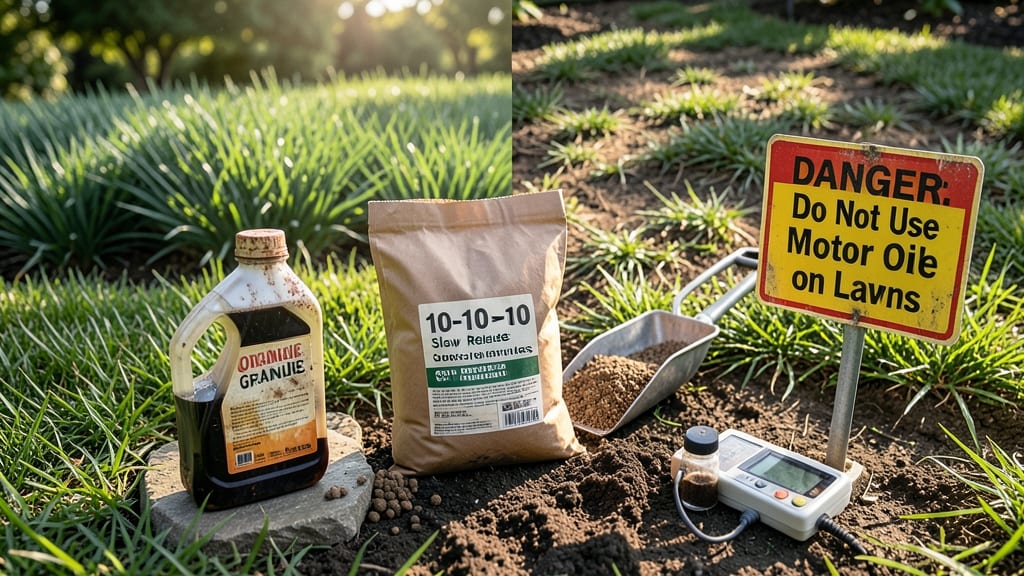
You can't use old motor oil to fertilize your lawn—it clogs soil pores, smothers roots, and introduces toxic heavy metals that poison plants and pollute water supplies. Stick with proven organic fertilizers instead.
You can you use old motor oil to fertilize your lawn? Absolutely not—it’s a terrible idea. 🌱 The thick petroleum layer coats soil particles, preventing air and water from reaching plant roots, which leads to stunted growth or death.
Even worse, motor oil contains lead, zinc, and other heavy metals that build up in soil over time, eventually seeping into groundwater. I've seen lawns treated this way develop yellow patches and dieback within months, despite the initial dark, oily sheen that might look like a quick fix.
Instead of risking your lawn's health, try compost, worm castings, or fish emulsion—these break down naturally and provide balanced nutrients without toxic residues. For best results, test your soil first to determine what nutrients your grass truly needs. A healthy lawn starts with healthy soil, not shortcuts.
💡 In This Article
- Toxic Effects of Motor Oil on Soil and Plants
- Safe Organic Lawn Fertilizer Alternatives
Toxic effects of motor oil on soil and plants
Motor oil doesn't just sit on top of soil—it seeps deep into the root zone, creating a waterproof barrier that suffocates plant roots. The thick petroleum residue coats soil particles, reducing porosity by up to 70% in affected areas.
This blocks both air and water from reaching roots, leading to oxygen deprivation that causes roots to rot within 2-4 weeks. 🌱 The dark, oily sheen might look like a nutrient boost, but it's actually a suffocating film that smothers microbial life essential for decomposition and nutrient cycling.
What makes motor oil especially dangerous is its cocktail of additives: heavy metals like lead and zinc accumulate in soil over time, while polycyclic aromatic hydrocarbons (PAHs) from combustion byproducts create long-term toxicity.
Studies show these chemicals persist for 5-10 years in soil, gradually leaching into groundwater where they contaminate drinking water supplies. Unlike organic fertilizers that break down into harmless compounds, motor oil creates a permanent toxic layer that harms not just your lawn but the entire ecosystem.
Even the smallest amounts—just 1 quart per 1,000 square feet—can create measurable damage. I've seen cases where homeowners applied motor oil as a "fertilizer" for quick greening, only to watch their lawn develop brown patches as roots suffocated.
The grass might look temporarily darker from the oil's staining effect, but the roots are dying beneath the surface. This is why professional landscapers universally condemn the practice—it's a short-term visual trick with long-term ecological consequences.
Contrast this with organic fertilizers like compost, which improve soil structure while providing nutrients. Compost increases soil porosity by 30-50% while supporting beneficial microbes, whereas motor oil does the exact opposite.
The difference is night and day: one nourishes life, the other smothers it. 💥 For every gallon of motor oil applied, you're essentially applying a slow-acting herbicide that will kill your lawn from the roots up over time.
Another critical factor is how motor oil disrupts the soil food web. Healthy soil contains billions of microbes per teaspoon that break down organic matter and make nutrients available to plants. Motor oil kills these beneficial organisms by coating their cell membranes, creating a biological desert where nothing can grow.
This is why lawns treated with motor oil often develop fungal infections—they've lost their natural defenses against pathogens.
Consider this comparison: a 1-inch layer of compost improves soil health and plant growth, while a 1/4-inch layer of motor oil creates a toxic barrier that blocks all essential soil functions.
The choice between these two couldn't be more clear when you look at the long-term health of your lawn and the environment. 🌍